
Start an Athens Township Residents Search
A good Athens Township residents directory search starts with the record that fits the question. An address is best tested through the parcel roll, map context, and the recorded land trail. A supplied name can be checked against a voter record or a court index, but only with another identifying detail. An old household question belongs with dated directories, newspapers, census material, and probate sources. Each source has a different purpose. A property owner is not automatically the current occupant, and a dated directory listing is not proof of a current address.
The local geography matters before the first search. Athens Township includes much of the City of Athens and a remainder outside the city. A line that says Athens, Ohio can therefore point to city-held material, township material, or county-held material. Save the exact spelling, query date, parcel number, document date, and source URL as the search moves between systems. That simple record trail is the best defense against confusing similar names or nearby addresses.
- Begin with an address, owner name, or parcel clue in the County Auditor property search. Preserve the parcel identifier and the way the street appears.
- Use the Recorder’s index to test a recorded property interest. Read the legal description and recording date rather than treating a name hit as a residence finding.
- For a supplied first and last name, use Ohio’s voter lookup with Athens County selected. Compare the result only with a separate official record.
- Choose the court by case type when a public court reference is involved. Record the case number, party role, date, and division shown by that custodian.
- For an earlier household, ask the history collections for a specific directory, telephone book, newspaper, probate, or obituary source dated to the period in question.
Note: A blank screen can reflect a protected record, a source gap, a different jurisdiction, or a spelling variation, not a final answer.
Athens Township Residents Record Custodians
No single Athens Township residents directory contains every household. The Auditor is the first county stop for a present parcel clue. The Recorder keeps the recorded-document index and deed images. The Board of Elections keeps registration and report tools subject to statutory exclusions. Court offices, the township, and the City of Athens each hold narrower records. Starting with the office that created a record avoids a broad request for someone to build a person profile. Street-level parcel steps belong in the Athens Township street directory reference.
Athens County Recorder
15 S. Court St., Room 236
Athens, OH 45701
740-592-3228
Recorder and AvaWeb access
Athens County Auditor, Real Estate
15 S. Court St., Room 330
Athens, OH 45701
740-592-3223
County property search
Athens County Board of Elections
15 S. Court St., Room 130
Athens, OH 45701
740-592-3201
Board of Elections contact
Athens Township Parcel and Deed Clues
The Auditor’s live search uses one combined field, labeled “Parcel, Owner, House# and St Name.” It is a practical entry point for a property clue, not a confirmed whole-street or ZIP search. The public source describes property value, acreage, building size and characteristics, construction details, and other parcel information. Its current screen does not establish that every parcel displays every field, so preserve what the actual result shows.
| Auditor field | Use in an Athens Township search |
|---|---|
| Parcel | Connect a known county parcel identifier to its record. |
| Owner | Find a current property-record lead, then verify it in a recorded instrument. |
| House# and St Name | Begin from a street-address clue and save the returned parcel context. |
From there, use the Recorder’s AvaWeb land-record route to find the recorded instrument. The Recorder says its real-property records and alphabetical indexes extend from 1790 to the present, and online document viewing and printing are free. A deed’s legal description, not a map line or mailing label, is the durable link between an address and a recorded property interest.
View the Athens County Recorder page before following a document trail.
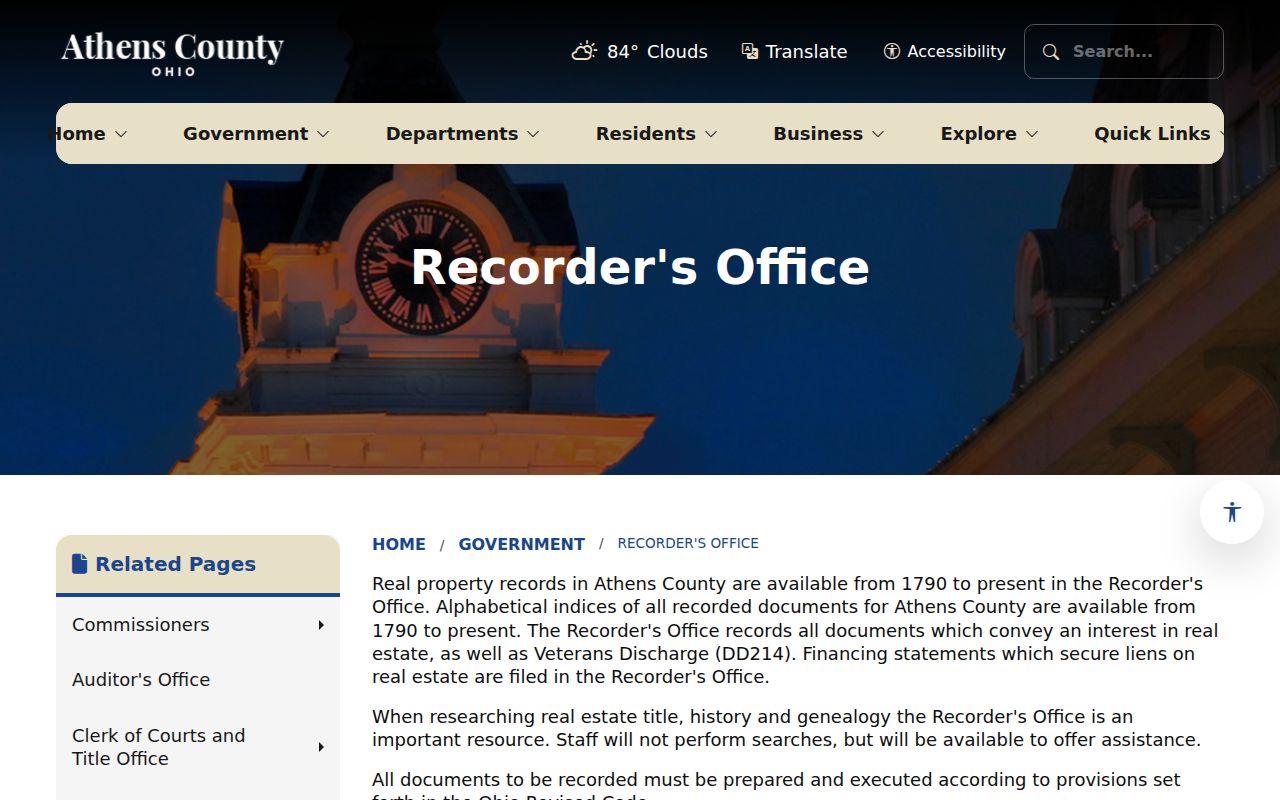
The Recorder source is the formal route for instruments and copies, while the property search supplies the parcel context that makes the document trail usable.
Athens Township Address Geography Matters
Athens Township is not interchangeable with the City of Athens or every postal address that reads Athens. The 2020 governmental-units table separates 30,163 township residents into 23,595 people in the city portion and 6,568 in the remainder. That split is a strong reason to use a parcel and GIS context before asking the City of Athens for a permit file or the township for a zoning record.
The township’s zoning description uses Pine Street, the Hocking River, Slater and Porter lanes, Lemaster Road, and Connett Road as practical cues for its zoned area. Those landmarks are not a substitute for a jurisdiction finding. The county GIS holds tax plats, historic tax plats, surveys, subdivisions, and related map context, but the county calls its GIS mapping approximate and tax-purpose. A deed or survey controls the legal boundary.
- Parcel
- A county property identifier that anchors a property-record search.
- Situs address
- The physical location of land or a building, distinct from a correspondence address.
- Legal description
- The lot, tract, plat, or survey language in the recorded document that identifies real property.
- Index
- A finding tool that points to a record; it is not automatically the underlying image or certified copy.
Note: A postal city name can be useful for delivery, but it does not decide whether a city, township, or county office holds a record.
Current Athens Township Residents Sources
Current Athens Township resident records are partial, purpose-built sources. The parcel roll can identify an owner attached to a current county property record. The statewide voter form confirms public registration information for an entered first name, last name, and county. County voter reporting can produce permitted election reports with address-oriented sorting. Court systems identify public case material by the court that owns it. None of those sources is a complete roster of everyone at an address.
| Record source | What it can support | Local keeper | Access route |
|---|---|---|---|
| Parcel roll | Owner, parcel, address, and published property context | County Auditor | Free combined query |
| Recorded-instrument index | Parties, conveyance trail, and legal-description lead | County Recorder | AvaWeb or counter |
| Voter lookup | Public registration information for a supplied person | Ohio Secretary of State | First name, last name, county |
| Voter Reporting | Permitted precinct or walking-list report at its file date | Athens County BOE | Report or CSV controls |
| Court docket route | Public case party, number, event, and status clue | Relevant court clerk | Portal, counter, or request |
Use a property source for a property question, a voter source for an election-record question, and a court source for a court question. A one-person search needs corroboration across independent sources. The Athens Township resident lookup route focuses on that verification work rather than a street or parcel trail.
Athens Township Voter Record Limits
Ohio My Voter Information requires a first name, last name, and county. Select Athens County for a township question. Its search tips tell users to test a derivative first name, a former last name, or a prior address when a result does not appear. The county’s Voter Reporting tool is different. It can produce a PDF, CSV, or statistical report and offers alphabetical, precinct, walking-list, and precinct-walking-list sorts.
The local reporting form also offers controls for household grouping, voter districts, selected elections, party filters, voting-history inclusion, and residential versus mailing-address output. Those options do not make an election report a household census. Ohio law excludes protected identifiers, confidential registrations, protected-worker addresses, telephone, email, and specified other data. Voting history reflects participation as allowed, not a voter’s choices.
Use the Ohio voter lookup for a narrowly supplied individual and the county tool only within its displayed report controls. Record the output’s date. The voter report itself showed its own August 2026 refresh date, a reminder that election data are snapshots.
Athens Township Court Record Paths
Court records are divided by custodian. Common Pleas CourtView is the county route for general and domestic-relations docket activity. Municipal eServices handles the Municipal Court’s public information and payment path. Probate and Juvenile CaseLook covers probate, estate, guardianship, marriage, and juvenile court functions, with stronger confidentiality limits for juvenile material. Federal matters use PACER, not the county portals.
An online docket is a lead, not a certified result. Municipal rules say general docket information is online, while documents that are unavailable online may be reviewed at the public terminal or case file when available. Probate warns that online posting can lag at least 24 hours. Sealed and expunged records are unavailable to the public, and court records must protect specified identifiers. Ask the clerk for an identifiable case and the exact copy needed.
See the Common Pleas CourtView portal for the county’s court-specific route.
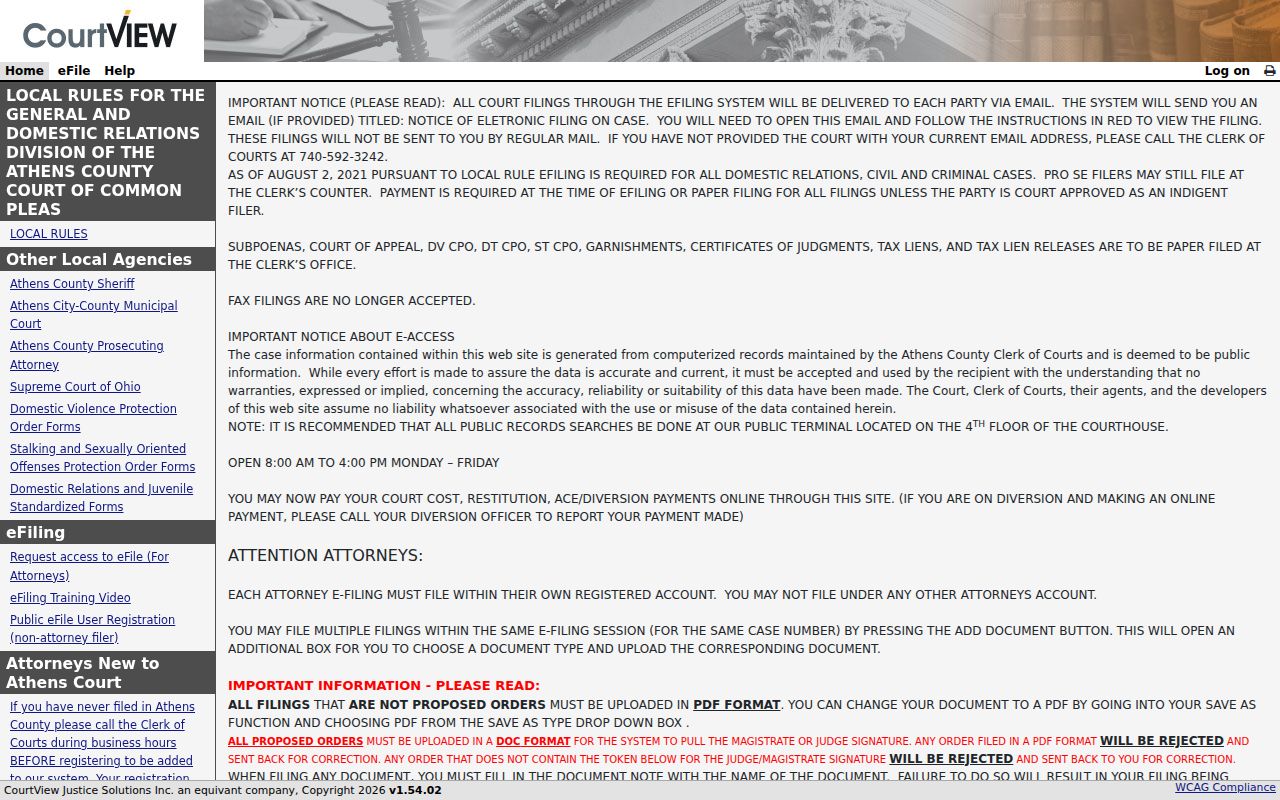
The portal image reinforces why a court name, division, and case number should travel with a result before a clerk copy is requested.
Note: A missing docket result may mean the wrong court, a date lag, a restricted file, or no matching public case.
Ohio Records That Add Context
Some state routes can add a limited fact to an Athens Township search. Ohio Vital Statistics is the proper state route for a post-1908 birth or post-1972 death certificate request, subject to the rules in R.C. 3705.23. The state’s published standard certificate figure was $21.50 at research time, but the receiving office should confirm the current amount before an order. Earlier county material is an archive or Probate inquiry, not an implied online result.
eLicense Ohio is different again. It verifies a credential through the appropriate board by name or license number and reports daily updates. A credential entry is not proof of a home address or a match to a property or court record. The record is useful only when its exact name, credential, board, status, and displayed date are preserved.
Open eLicense Ohio when a credential must be checked with its actual regulating board.
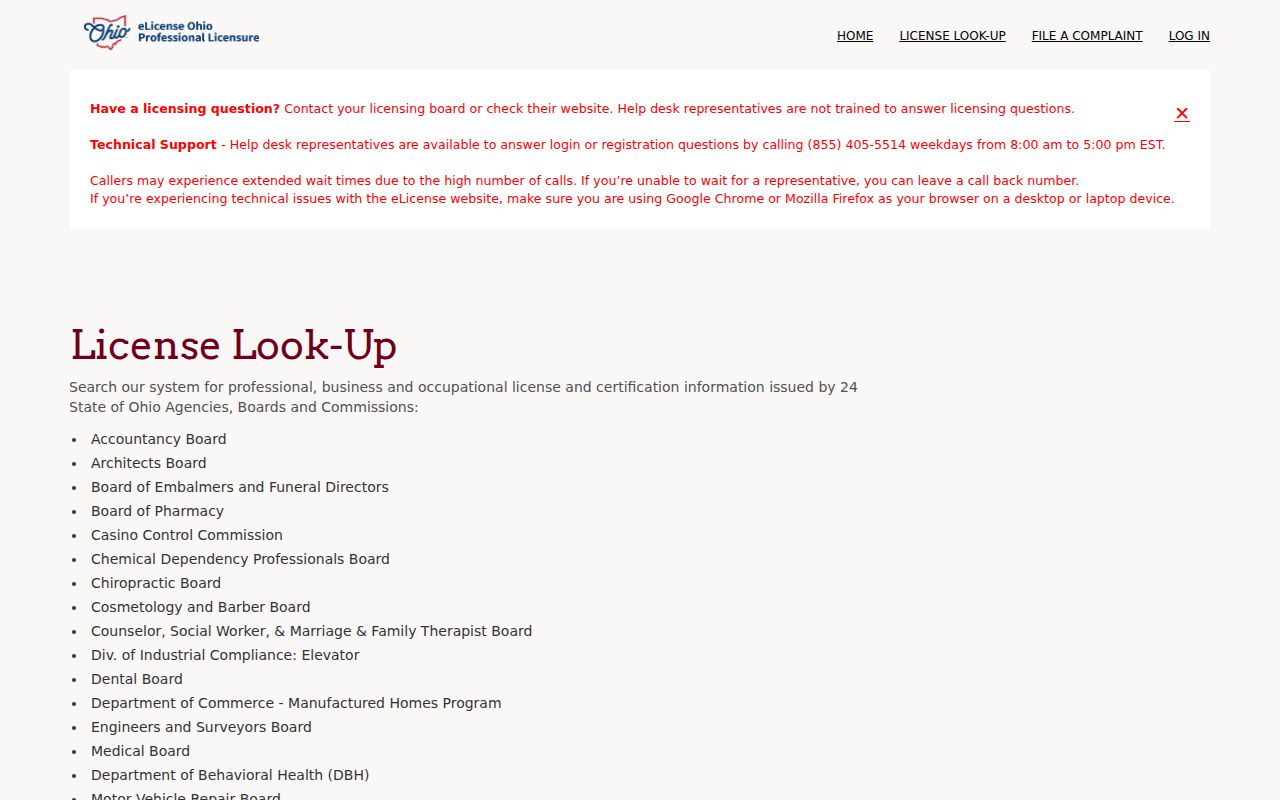
This official state route confirms a board record, which should remain separate from address or household evidence.
The Ohio Vital Statistics portal is the starting point for a state certificate request.
Vital-record access is a copy and custodian question, not a shortcut to a complete person profile.
Historical Athens Township Resident Collections
Historical Athens-area sources are unusually useful, but each has a stated date and geography. The Southeast Ohio History Center holds city directories, telephone books, obituary indexes, newspaper microfilm, estate packets, marriage-index microfilm, and wills. Its public descriptions confirm collection types, not a complete township-wide yearly directory run. The 1932 directory is a city-and-vicinity resource. A rural route or a township-edge address can be absent without proving that no household was present.
For a dated household question, request the exact edition, page, and source date. Then compare it with a census release, obituary, probate record, or deed trail appropriate to the period. The full collection methods and entry-reading details are kept with the Athens Township city directory materials. A directory indicates a printed association at its publication time; it does not settle later occupancy, ownership, or contact preference.
Note: Ask the collection holder about city-directory, telephone-book, and cross-reference holdings rather than assuming every year or rural address is present.
A 1932 Athens Directory Snapshot
Ohio University Libraries digitized the 50-page 1932 Directory of Athens and vicinity, published by Daugherty & Spaulding and held originally by the Southeast Ohio History Center. The inspected alphabetic pages can include a surname, given name or initials, spouse notation, occupation, affiliation, street address, children’s names and ages, widow notation, and business material. That rich format makes it more useful than a bare name list, but only for the directory’s own date.
A transcribed entry should retain its spelling, initials, page image, street form, and publication year. Pair the entry with the nearest released census or an obituary, newspaper, probate, or Recorder source before treating it as the same person in a later record. The published volume does not display a universal owner or renter mark in the inspected alphabetical page, so it should not be described as one.
Explore the digitized 1932 Athens directory as a fixed historical source. The historical work remains subject to the same rule as current research: name the actual source and distinguish a dated record from a present claim.
Athens County’s Uneven Record Timeline
The Recorder states that real-property records and alphabetical indexes run from 1790 to the present, while county history says Athens County was founded in 1804 and organized in 1805. The research does not resolve why the Recorder’s stated span begins earlier. Treat that published date as an index-coverage statement, then ask Recorder staff about the earliest particular instrument. It is not a promise that every early record has an equivalent online image.
The local courthouse story also argues for care. The first log courthouse burned in 1817, a brick building followed, and the present courthouse was dedicated in 1880. These dates explain why an older record may involve an original, index, transcription, later copy, or archival channel. They do not prove that all pre-fire records vanished. The History Center and the responsible county office are the correct places to ask about a specific series.
Privacy Limits for Athens Township Searches
Ohio’s Public Records Act opens many records held by public offices, but it also contains exemptions and redaction duties. Voter information has specific exclusions. Safe at Home participant information is confidential. Sealed and expunged court material is unavailable, and a public parcel or historical-directory entry does not authorize republishing or targeting a person. If a field appears wrong, take the correction request to the custodian that created it, with the parcel, case, or document reference that identifies the issue.
Read Ohio Revised Code 149.43 for the public-records statute before preparing a request.
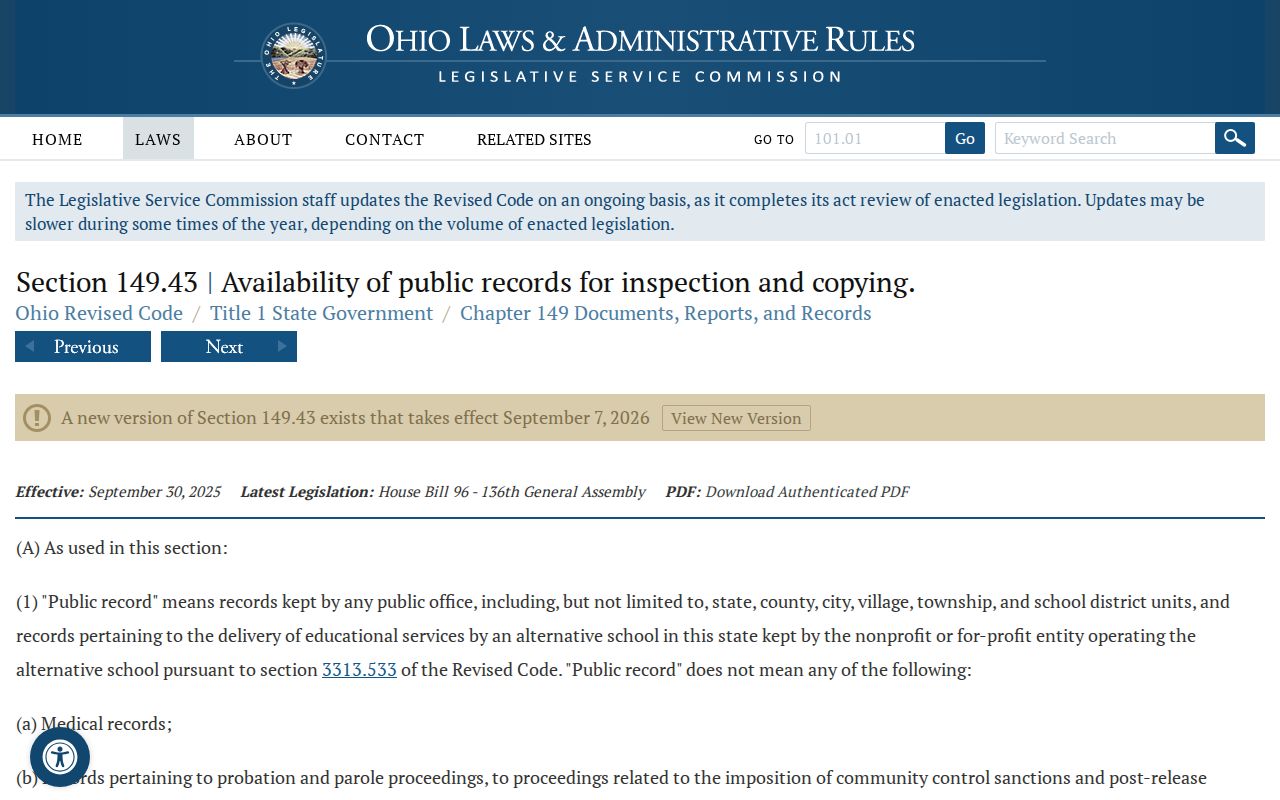
The statute identifies the record-access framework, while the office that holds a particular record decides which exemptions or redactions apply.
Ohio also has a defined online-redaction process for certain personal information in internet-posted records under R.C. 149.45. That route is not a general rewrite of accurate public history. A careful request identifies the exact record, field, statutory basis, and custodian. A separate publisher’s copied listing requires its own privacy process.
Note: A privacy or correction request works best when it identifies the exact record and custodian rather than asking for a broad removal.
Check Athens Township Record Solicitations
A mailer, text, or email can quote a real parcel address, court caption, recording reference, or public official’s name without being authentic. A 2026 Ohio consumer alert warns that impostors may use genuine judge names or court details to make payment notices look convincing. Go independently to the Recorder, court, or agency contact rather than using the sender’s phone number or link.
Athens County offers a concrete deed-copy check. The Recorder says online image viewing and printing are free, while counter copies and certified copies have their own stated charges. Keep the original message, sender domain, and claimed record number. For a suspected fraud, preserve the material and use the appropriate official reporting channel. Do not post another person’s address or inferred identity to a public forum.